Collective (weave)choreography Gothenburg (2024)
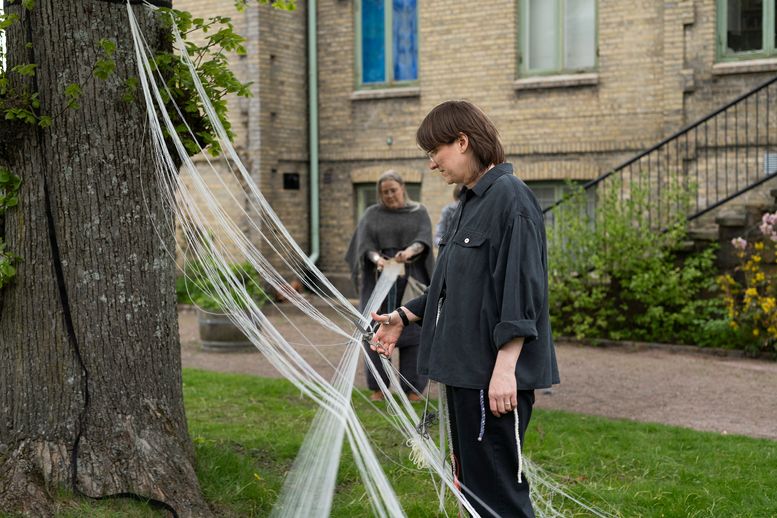
Collective (weave)choreography, performance outside Konstepidemin in Gothenburg during the Craft Days biennal, 4th of May 2024.
A performance by textile artist Matilda Dominique where she experiments with collective back strap weaving. The weavers are connected to their tools, the warp as well as to each other. Slow movements build materials. The same movements also affects the warp threads, that stretch out throughout the space. The body is making craft, simultaneously it is a tool for making. As the weaving proceeds, a temporary thread installation is created that opens up for new ways of experiencing the surrounding space.
Participants:
Naomi Sussex, Lisbeth Strømstad, Sofia Sterner, Mirjam Fält Gille, Carola Lektén, Susanne Sadri, Petra Haddad, Alexandra Nildén, Birgitta Hyvönen, Kerstin Sylwan, Annika Westlund, Anita Fors, Elynore Thorstenson, Carina Jensen, Mari Leion, Emma Leion Lundgren, Martina Björling, Johanna Engström, Therése Javér & Disa Falck
Photo: Hendrik Zeitler
Temporary Movements
Essay written for the Swedish Weaving Magazine
Issue 1, 2025
We stand in silence. We stand there quite a while; for me, every minute feels like an eternity. A seagull cries angrily overhead, people walk by. Some stop and observe, others sit down on the benches nearby and others walk on by. We weave. Each of us in our own heads. We work, together and by ourselves.
I wanted to gather a large group of people and weave together using rigid heddles. The warp ends would cross over each other and between the weaving bodies. The warp would form a pattern and simultaneously make up the boundary of a temporary installation. The bodies would be like sturdy pillars, with the function of keeping the threads tensioned. I also wanted to occupy a large space, build up my thread installation to suggest a new way of looking at the place. A line can be drawn and become a suggestion of a different reality. The material and the movement lay claim to the space and a new space can be created, if temporarily.
In my artistic practice I often work alone. In this project, which I call Collective (Weave)Choreography, I’ve gone against my usual way of working and invited a group of strangers, early in my process. It’s been necessary; in order to realize my idea I’ve needed many more weaving bodies than just my own.
A few years ago I took a freestanding course at Konstfack called Art in the Open: Social Dimensions, Ecologies, and Transformations. I began to explore ways in which I could use my weaving practice in the public space. I found a rigid heddle, watched a few YouTube videos to get started, and went to a park in Vårberg, south of Stockholm. I wound long threads between a bush and myself and started weaving. It was nice to work outside, exciting to interact with a different place than my normal one, a place I wasn’t familiar with previously. Weaving with a rigid heddle outside captured my interest. I didn’t care how the ribbon I was weaving turned out, instead I saw the potential in the method. What would it be like to weave as many, together, with long warp ends attached to each others’ bodies?
All of a sudden I am bound to a group of people that I don’t know from beforehand and may never meet again. We stand together, linked together with threads that stretch ten meters across the courtyard. From my body to your body. The threads are tensioned between us; if anyone moves, they affect the person attached to the other end. Here, on the lawn and the gravel under the trees between the yellow buildings of Konstepidemin, we’re dependent on each other. The art work couldn’t exist without our fellowship and none of us would be able to weave without the person across from us.
I gathered a group of people. The criteria were that those who wanted to be a part of it could participate that specific day and time, no prior knowledge of weaving necessary. I thought: as few limitations as possible, because I had no idea how many people might want to be a part of this. What I had to offer was participation in a collective artis- tic process, a workshop in rigid heddle weaving, and a small kit with tools and material. I was overwhelmed by the response. Choreography refers to a dance: movements that are synched or predetermined. There were twenty of us standing outside of Konstepidemin, making minimal movements, but still: our bodies and the threads that connected them were moving. The small movements I chose beforehand were those that occur when the heddle would be lifted or lowered, when weft was laid into the warp, and when the weft was beaten. It wasn’t about synching the weaving – the movements – but rather to be in stillness and weave at the same time, together. It was about letting the threads be in that place, stretched over a surface, creating a new space. I wanted to choreograph the shape of the space. How the threads would be tensioned, where the bodies would stand, and the relationship between threads, bodies, tree and surface.
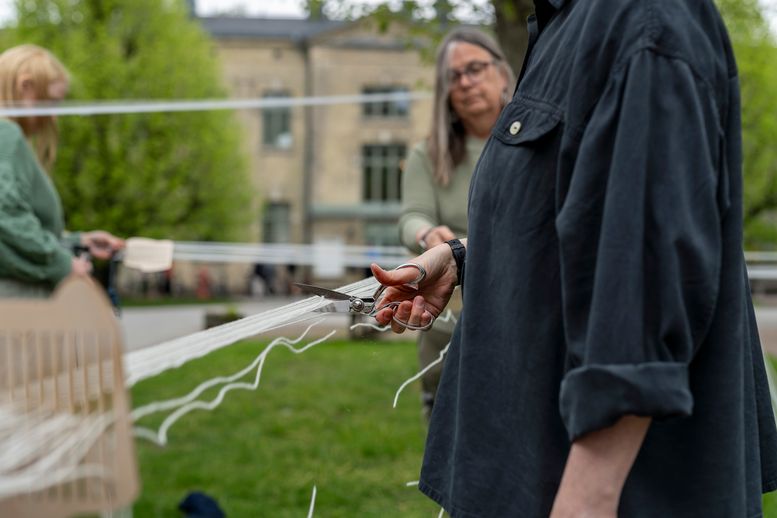
When the time was up – that is, the time I had predetermined that the performance piece would last, I unhooked myself from the warp that was attached to a belt at my waist. I picked up the scissors that lay on the ground in front of me and began to cut my way through the tensioned threads. One after another, the weaving bodies became free as the tension released and the work was finished.
© Matilda Dominique 2025